

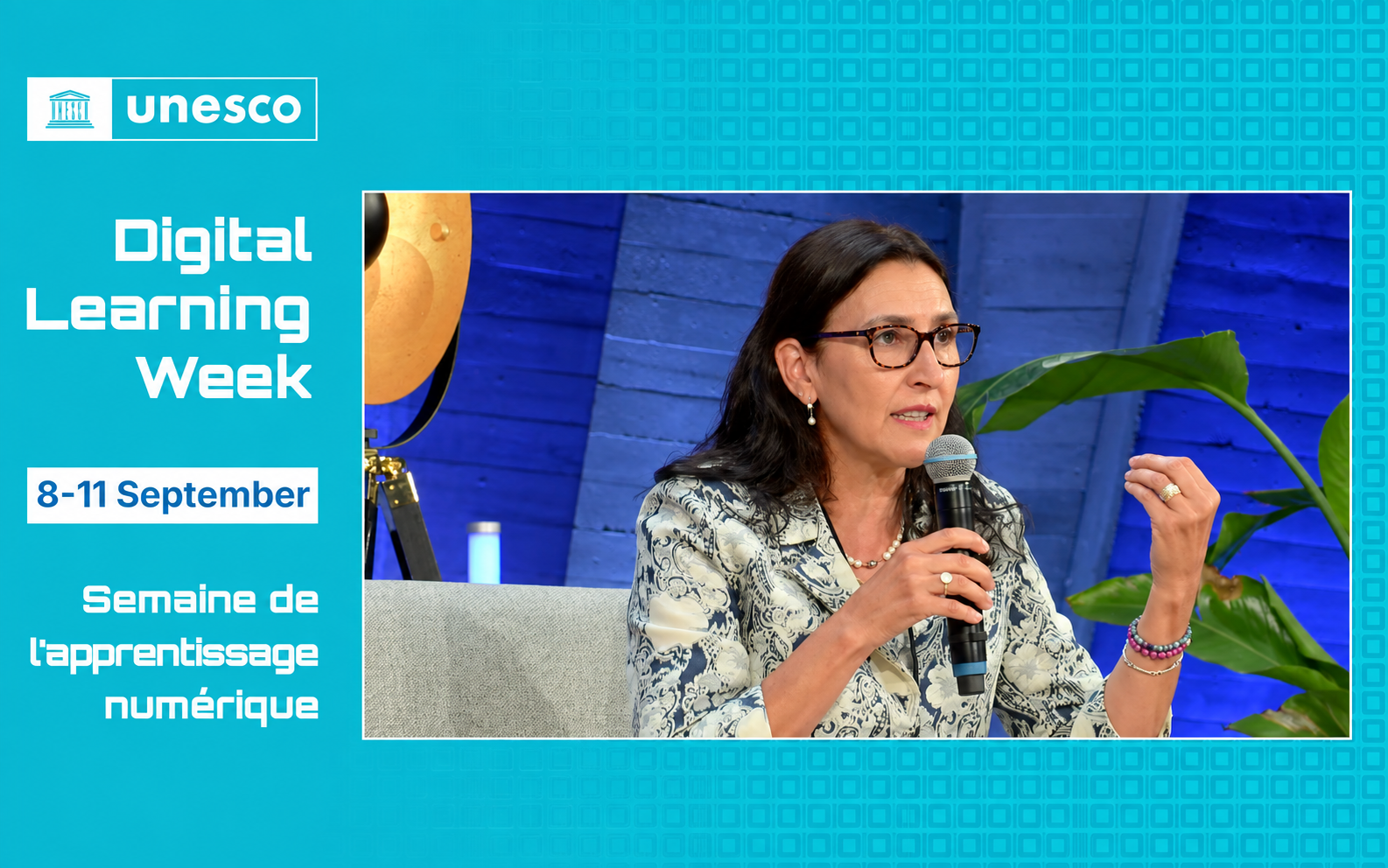
We would like to highlight the participation of our Secretary-General, Professor Magda Fusaro, in UNESCO’s 2026 Digital Learning Week, which took place in Paris from September 8 to 11 under the theme “Education in the Age of AI: Facts, Frictions, Frontiers.”
Beyond the conferences and various activities on the program, the event served as an important forum for meeting and dialogue among UNESCO Chairs, UNITWIN networks, and the UNESCO Secretariat. These exchanges provided an opportunity to share the experiences, concerns, and priorities of the various networks in the face of the rapid transformations brought about by artificial intelligence in the field of education.
Building on these discussions, Ms. Fusaro spoke on Thursday, September 10, during the session dedicated to AI governance and the future of education (Governing AI and Shaping the Future of Education).
In her remarks, she focused in particular on the changes that artificial intelligence is already bringing about within our universities. The challenge lies not only in determining how to educate students about AI, but also in understanding how AI is transforming education itself and, more broadly, higher education.
Ms. Fusaro thus described a restructuring that affects the entire academic community: students and faculty, but also the administrative structures and technical services that support educational activities. Given the scale of these transformations, policies and regulatory frameworks remain necessary, but they cannot alone ensure that education adapts to new realities and the needs of the labor market. This evolution will take time, and caution is necessary when it comes to sustainably transforming the ways we teach and learn.
We thank Ms. Fusaro for her contribution to these discussions and, more broadly, to this collective reflection among the UNESCO Chairs, the UNITWIN networks, and UNESCO on the future of education in the age of artificial intelligence.


